The Plumeria Way™ Framework
The Framework is the clearest way to understand how The Plumeria Way™ fits together. It shows how the five Phases organize decision-making, how Courses provide structured learning, how Field Books reinforce practical use, and how Bundles and visuals help simplify the path forward.
It is a structured system for deciding what is safer now, what should wait, and what learning tools best support the next step.
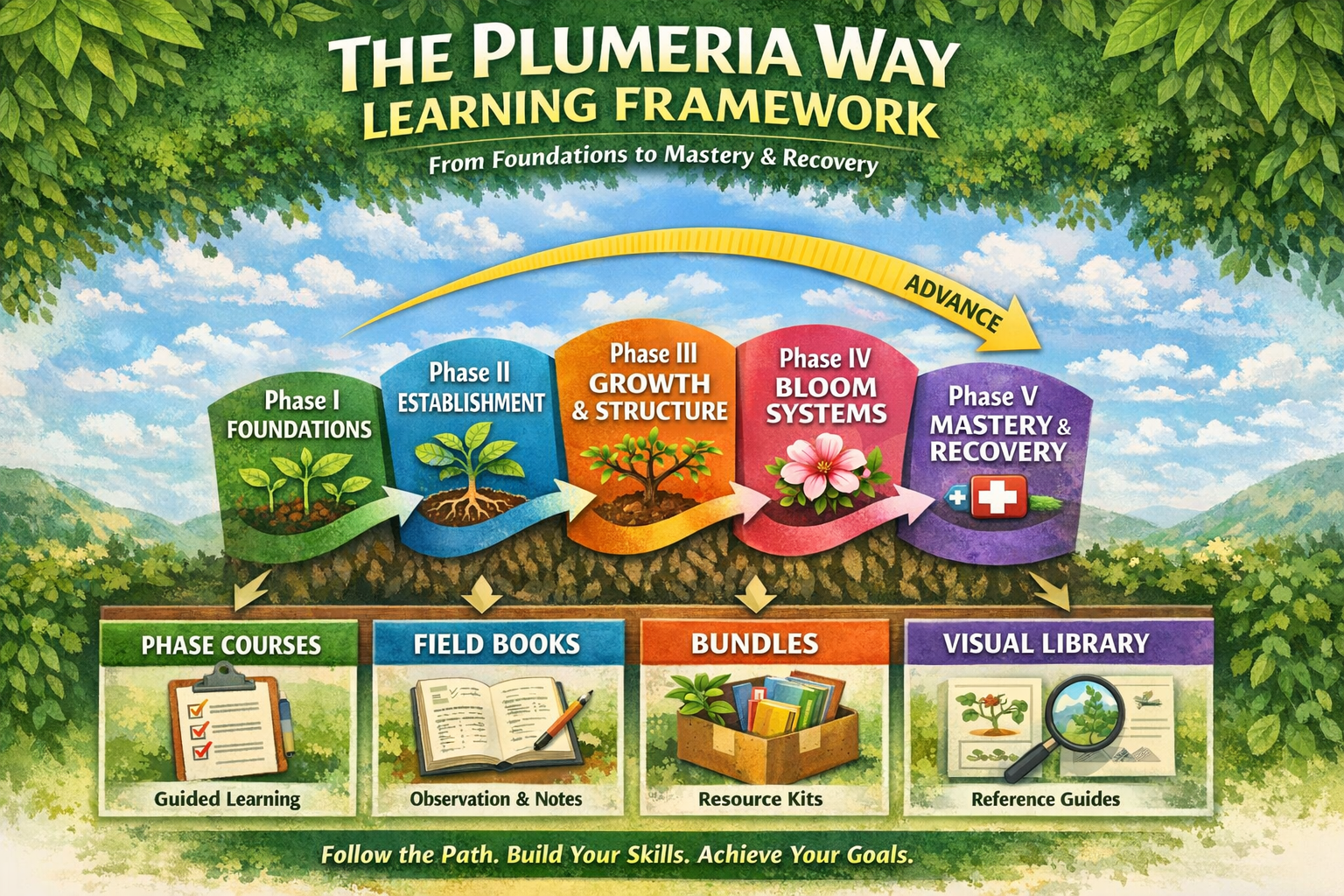
The Plumeria Way™ learning framework showing the five Phases and the supporting learning layers that help growers move from Foundation to mastery, diagnostics, and recovery.
What the Framework Does
The Framework organizes the system so growers do not have to guess where to begin or what kind of resource to use next. It helps match plant readiness, learning depth, and support tools in a safer sequence.
Defines readiness
The five Phases help determine what the plant can safely support now instead of relying on urgency, habit, or calendar assumptions.
Organizes learning
Courses, Learning Paths, and Field Books support different styles of learning while teaching the same core system.
Prevents overcorrection
The system reduces treatment-first thinking by placing observation, stability, and sequence ahead of intervention.
Simplifies the next step
Bundles, visuals, and companion tools make it easier to move forward without losing alignment with the framework.
How the Framework Works
The Plumeria Way™ works by moving from observation into structure, then from structure into the correct learning and support tools.
Step 1 — Start with the Phase
Begin by identifying the plant’s current Phase or the safest overall starting point. This determines what kinds of actions, expectations, and support are appropriate now.
Step 2 — Use the right learning layer
Once the Phase is clear, move into the right support layer: Courses for structured teaching, Field Books for bench-side reinforcement, visuals for quick interpretation, and Bundles for aligned resource sets.
Step 3 — Reinforce with companion tools
The system is designed so resources support each other. Learning is clearer when the Phase, course, book, and companion tools all point in the same direction.
Step 4 — Progress without drifting
The Framework helps growers progress through the system without skipping steps, mixing signals, or jumping into performance-driven decisions too early.
Better sequence leads to better interpretation, safer action, and more repeatable results.
The Five Phases
The Phases are the structural backbone of The Plumeria Way™. Each Phase represents a different level of readiness, purpose, and safe action.
Phase I — Foundation
The beginning of the system: language, orientation, observation habits, and the core thinking that supports all later decisions.
Phase II — Establishment
Rooting, stabilization, setup support, early environmental control, and the conditions that help the plant become more secure.
Phase III — Growth & Structure
Seasonal growth, plant architecture, branching logic, pruning thought process, and long-term structural development.
Phase IV — Bloom Systems
Flowering, bloom timing, bloom support conditions, and the environmental and cultural factors that influence bloom performance.
Phase V — Mastery, Diagnostics & Recovery
Advanced interpretation, troubleshooting, stress patterns, diagnostics, recovery logic, and higher-level cultivation judgment.
The Supporting Layers
The Framework is supported by multiple connected learning layers. Each one serves a different role, but all of them reinforce the same decision structure.
Courses
Courses provide the main structured teaching pathway across the five major Phases.
Field Books
Field Books reinforce practical use through observation support, note-taking, reference structure, and real-world application.
Bundles
Bundles simplify selection by grouping aligned resources into clearer, lower-friction entry points.
Visual Library
Visuals help explain the system quickly through diagrams, comparison tools, reference graphics, and roadmap-style support.
Visual Roadmaps and System Views
The visual side of the system helps growers and students understand the bigger picture faster. Use framework graphics, dashboards, and roadmap views to connect the parts of the system more clearly.
Framework View
Use this page as the central visual reference for how the system is organized.
Roadmap Views
Roadmap-style visuals help show how growers move from entry points into Phases, learning layers, and progression routes.
Dashboard Views
Dashboard visuals help connect Phases, Courses, Field Books, Bundles, and support pathways in one view.
Reference Graphics
Use diagrams and graphic references to reinforce key decisions and explain the structure to others more easily.
How to Use the System
Use the route below when you want the clearest way to enter and move through The Plumeria Way™.
Start Here
Begin here if you need the safest broad entry point into the system.
Find My Phase
Use this route when you need to identify the stage that best matches your plant and your next decision.
Choose a Course
Move into Courses when you want structured teaching tied directly to the Phase system.
Add Companion Tools
Add Field Books, Bundles, and visuals to reinforce learning and simplify practical use.
Start with the safest Phase perspective, move into the correct teaching layer, and reinforce learning with aligned companion tools.
It is the clearest way to understand how The Plumeria Way™ fits together before you move into Phases, Courses, Field Books, Bundles, and the Visual Library.