
Diagnostics Field Books
Diagnostics Field Books help you preserve evidence, separate categories correctly, and confirm the real cause before you act. The D-Series is built for evidence-first troubleshooting so treatment decisions are based on proof rather than urgency, assumption, or symptom chasing.
Do not treat what you have not confirmed.
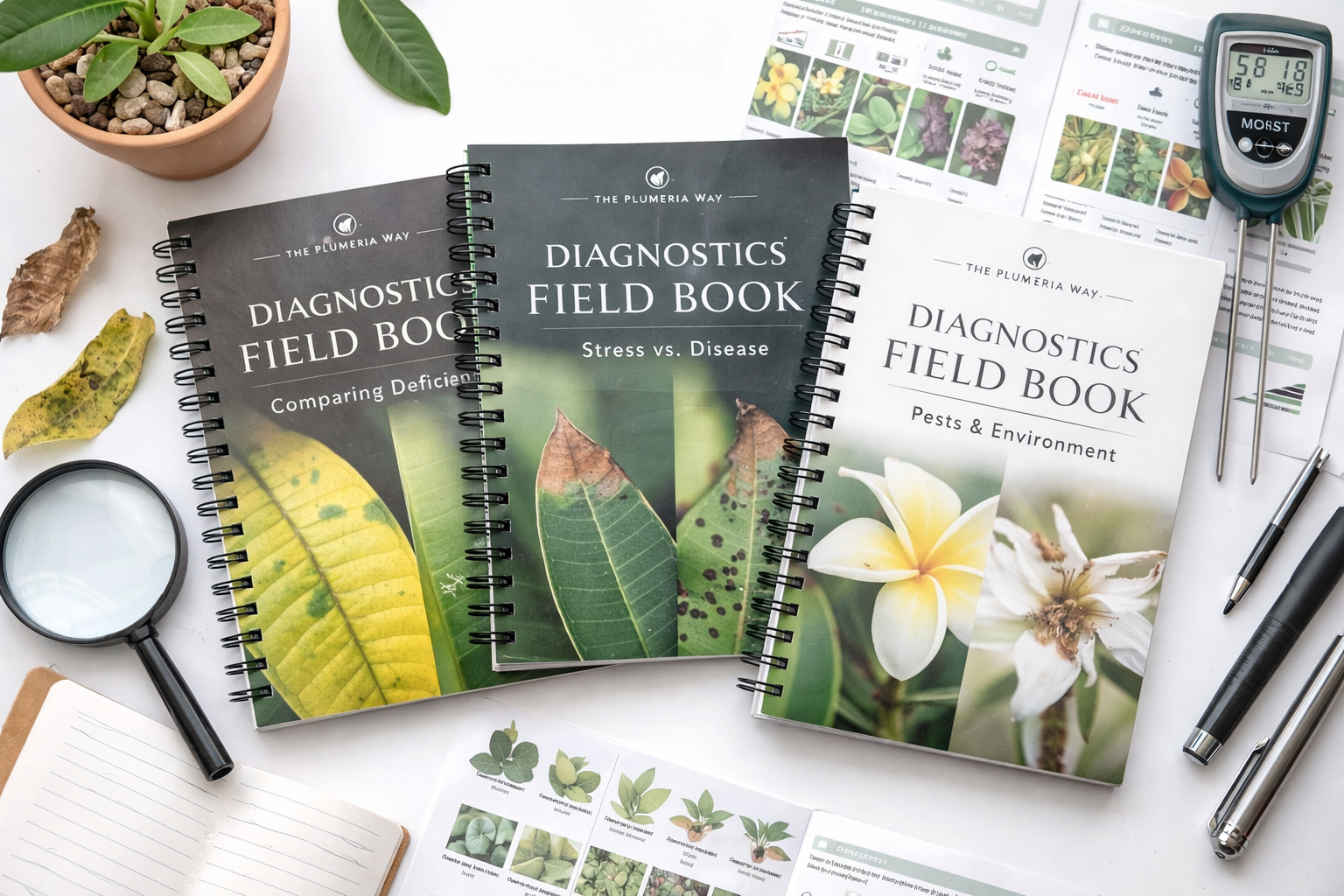
What Diagnostics Field Books Do
The D-Series teaches diagnostic discipline before corrective action. It helps growers slow down, preserve evidence, compare look-alike problems, and reduce the damage that comes from reacting too quickly.
Preserve evidence
These books help you avoid destroying the very clues you need in order to know what is actually wrong.
Separate categories
The series is built around distinction: pest vs disease, culture vs chemistry, stress vs progression, symptom vs cause.
Reduce wrong-first moves
By organizing evidence before intervention, the D-Series helps reduce unnecessary pruning, spraying, feeding, and treatment escalation.
Who This Series Is For
Growers facing unclear symptoms
Use this series when symptoms look mixed, timing is unclear, and surface appearances could point in more than one direction.
Growers trying to stop reaction-driven treatment
The D-Series is helpful when the bigger problem is not lack of action, but acting too fast from the wrong diagnosis.
Growers building stronger case judgment
These books support more disciplined thinking around plant signals, environmental patterns, and the real order of troubleshooting.
D-Series Volumes
The Diagnostics series moves from foundation-level diagnostic thinking into category-specific comparisons and case-based practice.
D1 — Diagnostic Foundation
Build the first principles of evidence-first diagnosis so you know what to preserve, what to compare, and what not to assume.
D2 — Nutrient & Environmental Disorders
Compare nutrient-like symptoms against environmental effects so false deficiency conclusions become less common.
D3 — Pest Diagnostics
Learn how to interpret pest signs more carefully instead of treating every distortion, stipple, or weak tip as the same thing.
D4 — Disease Diagnostics
Compare disease categories more carefully so infection is neither underestimated nor assumed too early.
D5 — Cultural & Physiological Disorders
Work through non-pest, non-disease causes that often imitate more severe problems when the setup or timing is off.
D6 — Propagation & Nursery Failures
Use this volume when failures are happening in cuttings, seedlings, rooted plants, or nursery-stage material and the pattern needs cleaner interpretation.
D7 — Diagnostic Case Studies
Build comparison skill by working through more complete cases where multiple signals compete and the first answer is not always the correct one.
How This Series Fits the TPW System
Start with Something Is Wrong
Use the public troubleshooting entry page first when you need the broadest safe first route into diagnostics.
Support pattern comparison visually
The Visual Library supports quicker comparison when symptoms need visual reference before deeper reading.
Connect to the Phase V route
The D-Series supports the broader evidence-first path that also feeds into higher-level Phase V decision work.
Need Help Choosing Where To Begin?
I am not sure this is my first stop
Use the selector when you need help deciding whether your situation belongs in diagnostics, stabilization, or an earlier phase.
I need a broader public route
Return to Start Here when you want the larger entry structure for the full TPW system.
I need support help
Use Support & FAQ if you need help navigating the public side of the site or understanding the route.