
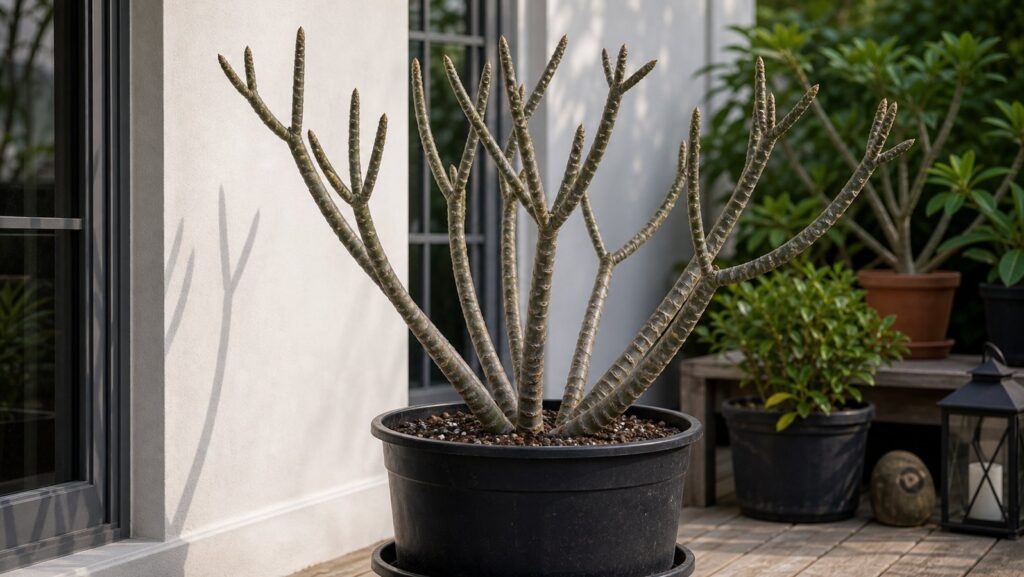
Understanding Plumeria Dormancy
Learn to recognize healthy plumeria dormancy, adjust water and feeding safely, and know when seasonal rest becomes a true problem.
Free introductory access: Use the enrollment button on this page. If prompted, sign in or create an account, then choose Take this Course to enroll at no charge. Returning learners can continue through My Courses & Account.
Dormancy Is a Plant Condition, Not a Calendar Date
Plumeria dormancy is a seasonal slowdown that helps the plant conserve stored water and energy when days shorten, temperatures cool, and usable light declines. Many established plants stop extending their tips, yellow and release leaves, and use very little water. A firm, stable, leafless plumeria can be healthy even though it looks dramatically different from its summer form.
Not every plant follows the same schedule or reaches the same depth of rest. A mature container plant in cool dry storage may become fully leafless and inactive. An in-ground plant in a warm subtropical microclimate may remain partly leafed. A seedling, newly rooted cutting, recent graft, or plant kept warm under strong light may remain semi-active and requires separate judgment. This course therefore teaches you to classify the plant you actually have rather than apply one winter rule to every plumeria.
What You Will Learn
- Recognize the whole-plant pattern of normal dormancy instead of diagnosing from one yellow leaf.
- Separate gradual seasonal slowdown from active decline, cold injury, pests, root trouble, and severe dehydration.
- Use light, temperature, plant activity, root-zone moisture, pot weight, stem firmness, and storage method to guide care.
- Distinguish fully dormant plants from warm or semi-active plants before deciding whether water is justified.
- Pause routine fertilizer and unnecessary treatments while roots and leaves are inactive.
- Build a brief monthly inspection that catches meaningful change without repeatedly disturbing the plant.
The Dormancy Decision Sequence
- Identify the plant and setting. Record whether it is an established plant, seedling, rooted cutting, recent graft, container plant, or in-ground plant. Note whether it is outdoors, in a greenhouse, under active indoor light, or in cool dry storage.
- Confirm the seasonal pattern. Look for a gradual combination of shorter days, cooler conditions, slower tip growth, reduced dry-down, older-leaf yellowing, and leaf release.
- Check structural stability. Healthy dormant stems remain firm. Soft tissue, spreading black or brown areas, foul odor, a loose trunk base, or persistent wet media do not belong to normal rest.
- Classify activity. Decide whether the plant is fully dormant and leafless, semi-active with retained leaves, or actively growing under warm bright conditions. Care follows this classification.
- Choose the smallest safe action. Often the correct action is protection, ventilation, rain exclusion, documentation, and waiting. Water, fertilizer, pruning, repotting, and pesticides require their own evidence.
- Define the next check. Record what you expect to stay stable and what change would trigger a closer diagnosis.
Watering and Feeding Boundary
A fully dormant, leafless plumeria in cool protected storage normally receives no routine watering. Do not add water merely because the surface looks dry or because a summer calendar says it is time. First check the entire root-zone context, pot weight, recent rain exposure, temperature, and stem condition. Severe shriveling should be investigated for dehydration, damaged roots, or soft tissue before any measured moisture is considered.
A plant that retains functioning leaves or continues growth in a warm, bright environment is not managed as a fully dormant stored plant. It may use some water, but the decision still follows measured dry-down and root condition rather than a fixed three- or four-week interval. Routine fertilizer remains paused for true dormancy; warm actively growing plants are evaluated from roots, light, temperature, current products, and demonstrated need.
Course Path
- What Dormancy Is in Plumeria defines healthy seasonal rest and its important look-alikes.
- Signals That Dormancy Is Beginning connects light, temperature, growth, yellowing, and dry-down.
- What Changes During Dormancy sets water, fertilizer, and treatment boundaries.
- Mistakes During Dormancy prevents summer watering, stacked corrections, and forced growth.
- Dormancy Decision Checklist turns the course into a repeatable monthly field routine.
Field Assignment
Choose one plumeria and create a dormancy record. Include plant type and age, growing method, current location, minimum and daytime temperatures, useful light, leaf status, tip activity, upper and lower root-zone moisture, pot weight, stem firmness, pest evidence, recent water and fertilizer, and protection from rain or frost. Classify the plant as fully dormant, semi-active, actively growing, or showing a possible problem.
State one action that is justified now and one action you will deliberately avoid. Set a date for the next inspection and name the evidence that would change your classification. The purpose is to create a record that makes quiet stability visible and makes real decline easier to recognize.
Stop and Diagnose Instead
Move out of routine dormancy care when tissue becomes soft, darkening spreads, the trunk base loosens, the pot remains wet in cool conditions, roots or media smell sour, pests are active, freeze damage is evident, or shriveling progresses despite an appropriate protected setting. A bare plant can be normal. A structurally deteriorating plant needs focused diagnosis and stabilization.
Completion Standard
You are ready for the mastery check when you can defend a dormancy classification from multiple observations, distinguish a fully dormant plant from a warm semi-active plant, make a condition-based water decision, explain why routine fertilizer is paused, and identify the exact signs that require escalation.